Inspiring Educator Learning

One of the greatest rewards and challenges in school leadership, whether it be informal or formal is how to affect the learning of others. What learning on the part of the educator will yield the greatest gains for the learners? When can they learn? How should they learn? How will I know if there is change in practice or outlook after the learning?

For me, it comes down to one thing, creating a culture of learning. From the top to the bottom of any educational organization, there has to be a sense of curiosity, a belief that everyone is capable of learning, a way to learn with others and a sense that any learning we do will improve the conditions for learning in our classrooms. It cant seem separate or other, or temporary, it has to be a seamless part of the system.

“Culture guides how we process information. Cultures with a strong oral tradition rely heavily on the brain’s memory and social engagement systems to process new learning. Learning will be more effective if processed using the common cultural learning aids—stories, music, and repetition.”
― Zaretta Lynn Hammond, Culturally Responsive Teaching and The Brain

How do you create the conditions for this culture? My tried and true techniques include;

  • Be a curious learner yourself
    • role model and
    • when small groups are working on an inquiry be present as much as possible,
    • especially on learning cycles that have potential for innovation.
    • Ask questions and show interest
  • Fan the flames
    • Encourage with key questions when an idea or wondering comes up; how could you do that, what needs to change, what don’t we know, what would our students say?
    • Rather than doing operational items at staff meetings, use them as a chance for ongoing sharing, wondering and collaborative direction setting
    • consider the power of sharing and collegial role modelling; try demo slams, goldfish bowls, unconferencing, ideation, and other innovative meeting and learning models
    • Celebrate gains and honour the learning that comes from failure (find a few brave staff to share their fails!)
  • Provide permissions
    • Yes, you can think about that topic, idea or question
    • We aren’t there yet, but do some research and bring me ideas on how we could get there
    • There is no right answer or wrong question
    • Yes, you can learn within the classroom environment
    • Your entry point is what it is, start where you are at
  • Resource the Learning
    • Find the release days for ongoing inquiry
    • Networking, connect the educator with the central resources, or resources in other sites
    • Reserve dollars for purchasing books, materials, and be transparent around how it is spent
    • Be creative in your timetabling and staffing, be willing to alter structures
    • Sponsor and organize the occasional ‘big event’, a speaker, a carousel

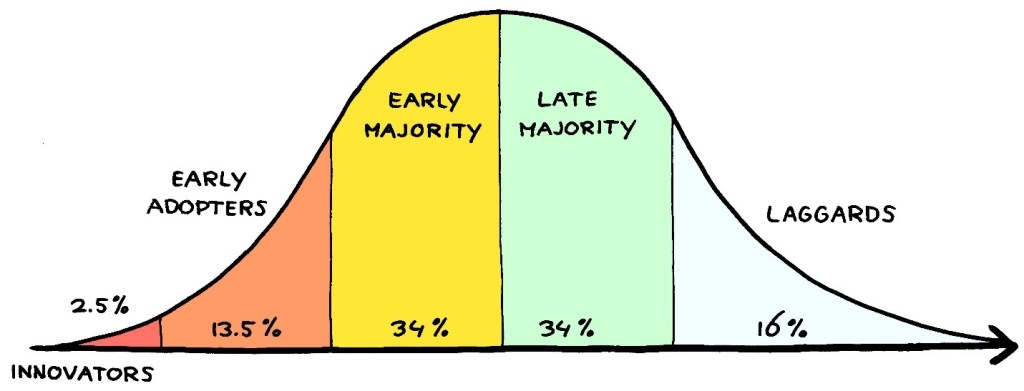
While these methods are tried and true and have worked well over the years, there are a couple of key things to keep in mind; 1. Be prepared for the ‘mundane’. Not every educator will come up with the next great idea to revolutionize the craft of teaching, some will spend time on late slips and classroom management. This is the cost of keeping everyone learning, they don’t all start with the same place you would. My thinking is that my high level of expectation is there for all, and they have to work on what they can influence in their learning, not how the student or system should change (sphere of influence). 2. Always keep the adoption curve in mind, big outcomes can come from your early adopters charging ahead in their learning, and you create the conditions for them to do so. Your leadership is really needed for the early and late majority, remembering as you go that some need to ‘do their way into learning, and some need to learn their way into doing’ (source unknown).
The best part about creating a culture of learning? It fills your cup and keeps your heart, mind and spirit engaged in the core work of our incredible profession; the art and science of teaching!


Shifting Gears. 3 Skills from Pandemic Leadership.

I started a new job in January 2020, moving from leading at a school to leading at a system level.  As I reflected on the new work I was engaged in (over a year ago,), I started writing this blog about transitions in my work-life; a new school year, a new school, or in my case a new job. You know, the whole ‘a change is as good as a rest’ philosophy.

So then what happened? The pandemic hit. Everything shifted. In really big ways.

I was assigned, as one of the central leaders, to help move an entire secondary school system of 23,000 learners into full distance education from March to June. From July to September we moved to creating a cohort, quadmester, in person, hybrid learning program, plus starting a full virtual high school for what would become 4600 distance learning students. Eventually, I became the Principal of this distance learning program in addition to my new System Leadership role.

Well, a pandemic response in an entire global education system remix will really make you think about shifting gears and the power of change in a whole new way.  

Too many large shifts can cause whiplash in those around us and a culture of uncertainty, or a sense that your organization has an identity crisis. We are clearly seeing that in the world of education in the pandemic.

“Too much change is not a good thing.. Ask the climate.” – Michael Scott, The Office.

And yet…

From the macro to the micro we are at our best when we realize that our current direction is not always the best direction.  New thinking has never been more possible. Just like a failing battery that needs a jump start, a school leader can reflect upon their Covid challenges and defeats for a valuable leadership reboot.

What got me through those huge pandemic changes and shifts was my existing skill set, but what made my work exciting, growth-based, and of service to others, was my smaller, but deeper shifts in my leadership learning.

“Every day the clock resets. Your wins don’t matter. Your failures don’t matter. Don’t stress on what was, fight for what could be”. -Sean Higgins

My areas of deepest leadership skills growth during this time of unrelenting change that have developed and served me the most have been; tapping into and growing my personal and professional networks, deep trust in my teams, and using every single interaction as a chance to show mutual humanity and common purpose. These are the skills I want to retain and build upon moving forward.

1. Personal and Professional Networks

Every person, every single one, who was an existing support, or a new introduction, became someone I was going to network with and potentially going to rely on. We all had a role in this work, a common goal of purpose meshed with survival, and a need to discard the old and create the new quickly.

It was liberating and comforting to build new, mutually beneficial relationships so quickly and see every single person as an asset who could help move our organization where it needed to go. If you crossed my path, I was going to see what you were willing to contribute to our shared goals, and it is my belief that this focus on interconnectedness brought out the best out in us both.

2. Deep Trust in Teams

Teams needed to the accessed, created, tasked and trusted quickly, and then disbanded when the work was done. I have always valued teams, but this Covid context forced growth in my ability to let them do the work, and share the vision, in a whole new way. The outcomes have been so transformative, that this must continue.

3. Humanity First – Every Damn Time

Listen, I am an introvert, which comes with its challenges in leadership and life. The crisis and pace of change needed in education and my new central role gave me a good smack of ‘you ain’t got time for that nonsense’ when interacting with others. Any sense of boundary or even an end to the work day ceased to exist. Not all of that is good of course, but it did push me deeper into the value of letting people in.

Showing others the struggle, letting them see the real me, and sharing the giddy, nerdy, joy when we accomplished something together paid off. Every email, announcement, vlog, newsletter, web post, phone call and the never ending video meets, became a chance to make a connection and show vulnerability.

And guess what? That open approach and vulnerability brings out the best in everyone. When used with the educators I was fortunate enough to lead, it allowed them to start to see their role with their students in that same way.

Humanity first. Trauma forward. Exceptions become the rule. Trust your people and trust yourself.

The growth in all of these things make all of it, all that crazy change, all that endless shifting…all of it is worth it.

Curious and Curiouser

As a school leader, I think that every good idea that has become a great practice or a true innovation has started with curiosity.  Inspiration is a mix of a desire to question, learn, and investigate, accompanied by the excitement of what is possible.

Curiouser and curiouser!” Cried Alice

(she was so much surprised, that for the moment

she quite forgot how to speak good English).

Lewis Carroll

I would correctly be described as a terrible listener, not intentional of course, but as an outcome of my restless mind.  The darn thing is always turning over ideas, problems and solutions and is easily stuck in the last thing that captured its attention.  The upside of this mental challenge is it’s accompanying ability to make connections, be intrigued, and proclivity for curiosity.

The spark needed for creativity and innovation can be  born out of open ended questions that in turn are driven by our natural curiosity.  Asking questions of parents, students, community members, family, friends, consultants, superintendents, bartenders (seeing if you were still reading!), and pretty much anyone you meet can make the world a wonderful and inspiring place.  The answers to our questions, and the reflection time you allow yourself to mull these answers over in order to make connections to your core work, is the birthplace of ideas. Unconferencing or open space professional learning is a prime example of the power of self-driven curiosity and questioning.

Let me give you a few ideas of the random open ended questions I sometimes ask people I’ve just met: What do you like best about your work? What is the greatest challenge to you or in your work?  How could education help with that? What would you want in an employee? How does that work? What was a fail for you? What is missing? If none of the rules applied what would you do or fix first? What do you want to know more about? What did you like about high school? Of course the list is endless!

Wanting to know stuff, and really allowing your inner curiosity to take the reins will allow for new seeds of inspiration to take root.  I guarantee it – no refunds, no exchanges.

Hurry Up and Wait

Upon graduation from teachers college, I worked in international schools for 5 years. The travel bug bit me hard at that time, and I traveled a lot in my life BC (before children). Based on those experiences, I often thought that Hell would be an airport waiting lounge. The kind with horrible music played a little too loudly, only one place to get a stale bite to eat, cold tile floors, broken air conditioning and hard plastic chairs with immovable armrests preventing you from lying down.

Another aspect of travel that makes it a bit of a personal hell for me is the constant ‘hurry up and wait’. Be there two hours early, rush to make it to the gate, but then sit and wait for hours because the plane is delayed or boarding is taking forever. After a panicked rush through stalled traffic in a cab, run to a dusty platform, then sit and wait, squatting on your backpack as a chair, for the local bus to come to take you to your next destination.

School leadership can be a lot like this. Hurry up and wait applies to my role as a school principal with great frequency. However, unlike travel glitches that happen to us, I like to be purposeful in my use of urgency vs. long term goal and action development. For me, understanding the balance between urgency and a patient plan is an important part of leadership.

There are times when urgency can and should be used to create engagement, quick outcomes and a general sense of action that make the work and school culture seem to have essential and critical importance. On other occasions, I want the work to seem ‘doable’ in its long term outcomes, with transparency, a clear vision, opportunities for feedback and collaboration. Then the eventual actions that will be undertaken by all can take time and be accomplished at one’s own pace. In either case, a strongly articulated vision, and providing my staff with a ‘why’ and ‘what’s in it for me’ is essential. Let me provide an example of a leadership challenge in the last year where both tempos applied.

Urgent leadership was required when our Vice Principals saw a significant rise in the number of student discipline incidents involving racist remarks and religious intolerance about a year ago. Hateful language and social media provocations were happening in and outside of classrooms in an increased frequency. The students and staff involved in these investigations consistently identified that we were experiencing an issue in our school culture.

I used an ‘urgent’ response to the situation to tackle the issue immediately while simultaneously reinvigorating our ongoing safe, caring and inclusive schools work. Myself and a Vice Principal quickly researched policy options, held short turnover meetings with my key influencers and decision makers within the school, and then designed and executed a new school policy with an eye-catching classroom poster, mandatory classroom roll-out and a school community communication plan. The policy clearly laid out value statements and the key responsibilities for the members of our school community. Overall: to value diversity and to firmly reject discrimination of any kind.

The patience part of this safe schools example was that I was fully aware that we were not changing hearts and minds with the mandatory implementation of a new equity policy. The real work takes time, growth, capacity amongst staff, and a cyclical process to make a real difference to the school climate.

The urgent response filled the need of defining ‘right’ and ‘wrong’ and making our values clear as a school community. Building empathy, compassion, and breaking down barriers for marginalized students in the long-range plan that will take time and patience.

Over the next year we established a student voice ‘roundtable’, developed and delivered staff PD, held our first Black History Month, had our first Pride week, and we just completed our first Mental Health and Well being week this May. We continue to resource and re-invigorate our school teams to study our perceptual data and engage students, parents and staff in determining new actions that demonstrate our commitment to making the words on that inclusion and equity policy ring true to the student’s experience. This will continue for many years.

I’ve purposefully selected a hurry-up-and-wait scenario that was a top down response to illustrate leadership sometimes requires us to step up and lead the change. However, this approach is just as true for initiatives and school solutions that come to us in a grassroots manner. We can empower, provide permissions, designate resources and give of our time in a way that allows for our students and staff who want to lead a change to have the same principle apply.

A quick burst of action, allocation of resources and decision making, followed by patient improvements, capacity building and cyclical reflections can yield amazing things. Much better than the airport waiting lounge!